
A “Prehistoric Kangaroo” Found Alive in the Philippines? The Photo Tells a Different Story
 Beyond Facts Team
Beyond Facts checks the stories and photos that race around Facebook. This one claims a living prehistoric kangaroo has turned up in the Philippines. We looked for the discovery behind the post — and then we looked at the photo again.
The Short Answer
No scientific discovery has been reported. No university, museum, journal or Philippine authority has announced a living prehistoric kangaroo in Mindanao — or anywhere else. And the animal in the photograph is not a marsupial at all. It is a perfectly ordinary dog, caught in the one pose that can make a dog look uncannily like a kangaroo.
The Claim, Word for Word
The post now circulating on Facebook announces that “scientists have reported the possible discovery of a prehistoric kangaroo species in the remote forests of Mindanao, Philippines, a species believed to have gone extinct since the last Ice Age.” The animal is described as resembling “the ancient but small dwarf version of Protemnodon,” spotted by “researchers and indigenous communities,” with “powerful hind legs and a hopping gait.” Camera traps and DNA analysis are said to be “underway.”
It sounds specific. It names a real extinct animal. It names a real island. But notice what it never names: a single scientist, a single institution, a journal, a date, or a place more precise than “remote forests.” Real discoveries arrive with all of those attached. This one arrives with none.
Look at the Photo Again
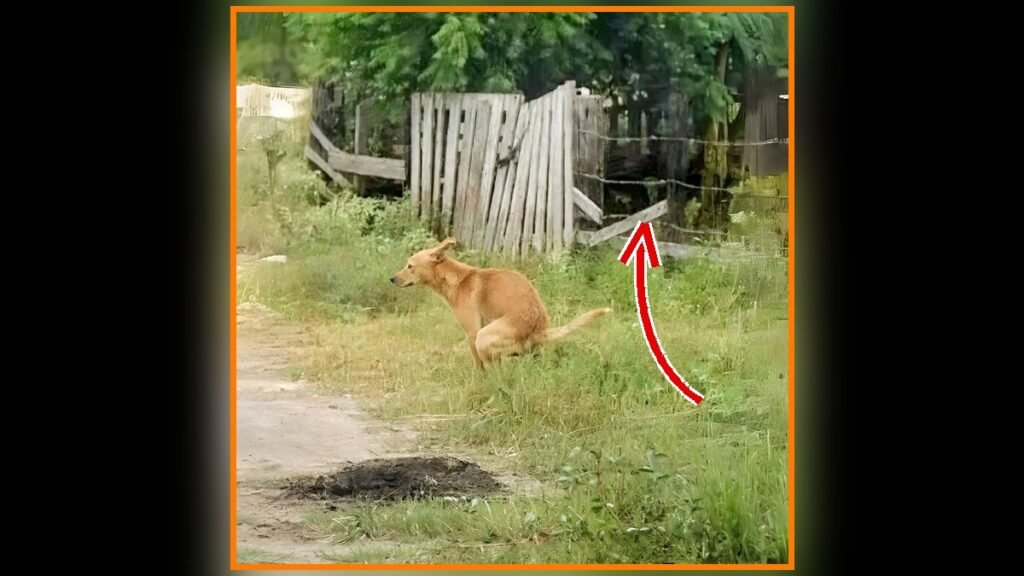
The photograph shows a tan animal crouched upright in the grass beside a dirt path, in front of a weathered wooden gate. Squint, and the kangaroo reading is powerful: big folded hind legs, an upright torso, a long tail trailing behind like a tripod leg.
Now look at the head. In profile it has a long, pointed canine muzzle, a black nose, a dark eye set the way a dog’s eye is set, and — folded back along the neck — a dog’s ear. Look at the front of the body and you can find the front legs, planted on the ground between the hind legs and easy to miss in the grass. Look at the tail: thin, low-carried, and entirely dog-like.
The “prehistoric kangaroo” is a village dog — the type known across the Philippines as an askal — photographed at the exact moment it squatted down to relieve itself. That crouch is the whole illusion. A squatting dog lifts its head, folds its front legs in close, balances on its haunches and uses its tail for support — and for one frame, the silhouette spells kangaroo. It is the same kind of accidental geometry that once made a famous photo appear to show actress Jennifer Aniston with three legs, which we examined in another Beyond Facts check: topwresler.site . Nothing in the picture is edited. The trick is entirely in the posture — and in the caption steering your eye before you look for yourself.
Protemnodon Is Real — and Really Extinct
The post’s one solid ingredient is its science name. Protemnodon was a genuine genus of giant kangaroos that lived in Australia and New Guinea during the Pleistocene, the epoch of the last Ice Age. Its species were giants next to today’s red kangaroo, and like the rest of Australia’s Ice Age megafauna, the genus vanished tens of thousands of years ago.
Protemnodon has also been in real headlines recently — which is almost certainly why the post borrowed its name. In January 2026, researchers from the University of Manchester, the University of Bristol and the University of Melbourne published a study in Scientific Reports examining the hind limbs of 63 kangaroo and wallaby species, living and fossil, including Protemnodon. Their finding made news around the world: even giant kangaroos weighing some 250 kilograms had foot and heel bones strong enough to hop — though probably only in short bursts, using thicker, less springy tendons than modern kangaroos: discovermagazine.com .
That study was about fossils. It reported no living animal, no dwarf species, and nothing in Asia. The viral post simply took a real, current science headline, kept the exotic name, and replaced the fossils with a dog.
Why a Kangaroo in Mindanao Would Rewrite Biology
If a hopping marsupial really were found alive in the Philippines, it would not be a quirky local news item — it would overturn one of the most famous patterns in natural history. The Philippines has no native marsupials at all. Kangaroos and their relatives belong to the Australian side of the Wallace Line, the deep-water boundary that has separated Asian wildlife from Australasian wildlife for millions of years. The closest wild marsupials to the Philippines are the cuscuses of Sulawesi and the Maluku Islands in Indonesia — and no kangaroo, living or fossil, has ever been recorded in the Philippine archipelago.
A living Philippine kangaroo would therefore need an explanation as big as the claim: an unknown migration across deep ocean straits, a fossil record that somehow left no trace, and a population that hid from everyone until now. Extraordinary claims are welcome in science — but they are announced by the institutions that verified them, with specimens, coordinates and data. A claim carried only by an anonymous Facebook caption, attached to a photograph of a dog, is asking you to skip every one of those steps.
How a Post Like This Is Built
Once you see the recipe, you will spot it everywhere. Take one real, impressive-sounding scientific name from a genuine headline. Add a real place, the remoter the better. Add unnamed “researchers” and “indigenous communities” for authority and colour. Close with tests that are forever “underway” — camera traps set, DNA pending — which conveniently explains why no proof can be shown today, or any day. Then attach a photograph that rewards a squint and punishes a second look. Each ingredient is cheap; together, they imitate the shape of a discovery announcement closely enough to travel.
The honest version of this story is still a good one: a charming optical illusion, a real Ice Age giant in the science news, and a reminder that the most convincing-looking posts are often the ones that name everything except a source.
The Verdict
Fabricated. There is no reported discovery of a prehistoric kangaroo in Mindanao; Protemnodon has been extinct for tens of thousands of years; the Philippines has no native marsupials; and the animal in the photograph is a dog in mid-squat. If camera-trap or DNA results ever genuinely emerge, they will arrive through a named institution — and Beyond Facts will happily update this page.
Frequently Asked Questions
Is the photograph fake?
The photograph appears to be a genuine, unedited picture — of a dog. What is fabricated is the caption and the discovery story wrapped around it.
Did scientists really study Protemnodon recently?
Yes. A January 2026 study in Scientific Reports, covered by outlets including Discover Magazine (linked above) and NDTV, concluded that even giant extinct kangaroos were built to hop in short bursts. It concerned fossils only, and no living species: ndtv.com
Are there any kangaroos or marsupials in the Philippines?
No native ones. Marsupials are Australasian animals; the Philippines’ wildlife is on the Asian side of the Wallace Line. Any kangaroo in the Philippines today would be an escaped or kept exotic pet, not a surviving prehistoric species.
Featured image: the photograph circulating with the claim, shown as it travels online. The animal pictured is a dog; no prehistoric kangaroo appears in it.





4 thoughts on “A “Prehistoric Kangaroo” Found Alive in the Philippines? The Photo Tells a Different Story”