
Not Christmas Decorations: Those Heavy “Pinecones” Your Girlfriend Found Are Cuckoo Clock Weights
 Beyond Facts Team
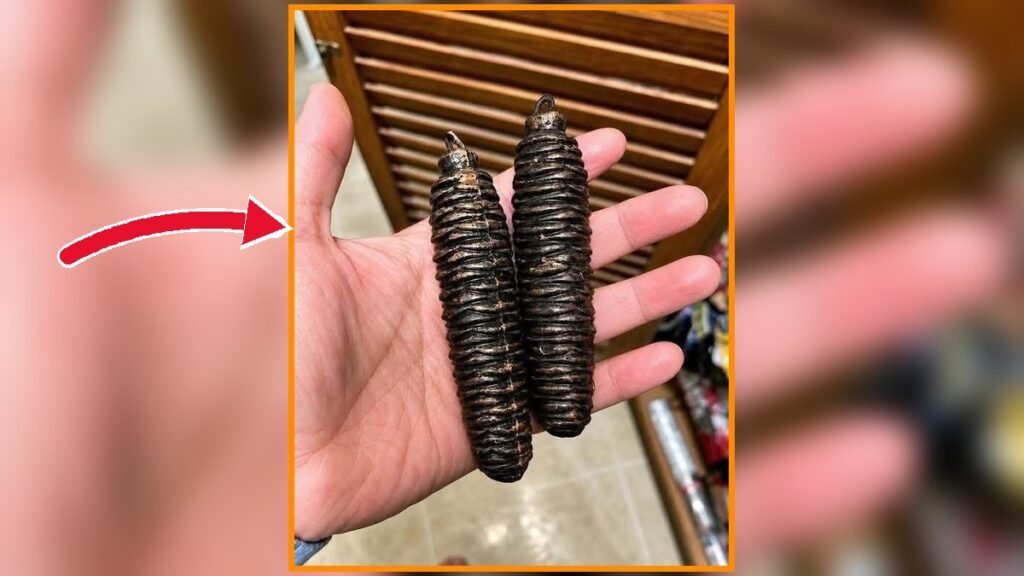
They look like a pair of pinecones that fell off a very ambitious Christmas tree. They are solid, dark, ridged — and absurdly heavy, far too heavy to hang on any branch. Found in a house where a grandmother and aunt lived all their lives, they feel like a riddle. Good news: this riddle has a satisfying answer, and it ticks.
The short answer: those are cuckoo clock weights — the cast-iron pinecone weights of a traditional Black Forest cuckoo clock. They were never meant to decorate anything. Their job was to hang from chains inside the clock and, by slowly sinking, power it. The weight that makes them ridiculous as ornaments is the entire point: gravity was the battery.
Why They Look Like That
Every detail in the photograph is a clue:
- The pinecone shape. Cuckoo clocks come from Germany’s Black Forest, and their carved cases celebrate the forest — leaves, birds, deer. The weights followed the theme, cast as pinecones. It is decoration, yes, but decoration in service of a machine.
- The hook on top. That little loop is not for a tree branch. It is where the weight hangs from the clock’s chain.
- The dark, worn finish. Traditional weights are cast iron, usually finished dark brown or black, often with coppery highlights that show through as the edges wear — exactly the look in this photo.
- They come in twos (or threes). Cuckoo clocks run on two or three weights. A pair is the classic set: one drives the timekeeping, the other drives the strike and the cuckoo call. A third weight means the clock also played music.
- The heft. Clock weights are solid cast metal, and they are made in precise sizes — commonly from about 275 grams up to 1,000–1,500 grams for large eight-day clocks (the full commercial range runs roughly 150 to 1,750 grams). The pair in this photo are on the bigger side of life.
How a Weight Runs a Clock
Before batteries, before plugs, a mechanical clock needed a power source, and the cuckoo clock’s is beautifully simple: falling weights.
Each weight hangs from a chain that runs over a sprocket inside the movement. As gravity pulls the weight down — slowly, over a day or a week depending on the movement — the chain turns the gears, and the clock ticks, strikes, and pops its little bird out on the hour. When the weights reach the bottom, the clock stops. “Winding” it means nothing more than pulling the free end of each chain to haul the weights back to the top, and the slow descent begins again.
That is why the weight has to be exactly right. Too light, and the movement hasn’t the force to run. Too heavy, and it can strain or damage the gears. Clockmakers matched specific weights to specific movements the way you’d match a charger to a phone — which is why these things come in such a fussy range of gram sizes, and why restorers hunt for the correct ones.
Why They Were Alone in the House
If there are weights, there was almost certainly a clock — once. Cuckoo clocks hung in millions of homes through the last century, and they were forever being taken down: moved, repaired, fallen out of fashion, broken, given away. The weights, being detachable and built like little anchors, tend to survive the separation. They migrate into drawers, cupboards and boxes of “heavy old things nobody can identify,” and they outwait everyone — cast iron is in no hurry.
So the most likely story in that house is a simple one: a Black Forest cuckoo clock once hung on a wall there, and when the clock left — whenever, however — its pinecones stayed behind.
Three Ways to Confirm It
- Weigh them. A kitchen scale is a genuine diagnostic tool here. If each one lands in the classic band (a few hundred grams to about a kilo and a half), that is clock-weight territory — far beyond any ornament.
- Look for numbers. Many weights are stamped with their gram weight. A number like 320, 420, 750 or 1000 is practically a name tag.
- Ask about the clock. If anyone in the family remembers a cuckoo clock — or if chains, a pendulum, or a carved wooden case turn up in the same clear-out — the case is closed.
What To Do With Them
They are not treasure, exactly — individual vintage weights typically sell for modest money, often in the tens of dollars, with correct matched pairs worth more to the right buyer. But they are genuinely useful and genuinely historical:
- Keep them — as paperweights and conversation pieces they are unbeatable, and they are a small iron piece of the family’s own house history.
- Pass them to a clock restorer — original weights are the missing part in countless restorations, and a restorer will know in one glance which movement they belong to.
- Sell or donate them — clock collectors actively buy them; measure, weigh and photograph them, and list the gram weight.
Whatever you do, don’t hang them on the Christmas tree. They spent a century learning one job — falling slowly, at exactly the right speed, so a wooden bird could announce the hour. A branch doesn’t stand a chance.
Frequently Asked Questions
What are the heavy pinecone things found in old houses?
They are cuckoo clock weights — cast-iron pinecone weights that hang from chains inside a Black Forest cuckoo clock and power it by slowly descending.
Why are cuckoo clock weights so heavy?
Because weight is the power source. The mass is calibrated to the movement: enough force to drive the gears, strikes and cuckoo mechanism for a day or a week per winding.
How many weights does a cuckoo clock have?
Usually two — one for timekeeping, one for the strike and cuckoo call. Musical cuckoo clocks have three.
Are old cuckoo clock weights worth anything?
Modestly — often tens of dollars each, more for matched, heavier or stamped pairs. Their greater value is as original parts for restorations.
Sources and Further Reading
- Ronell Clock Co. — cuckoo clock pine cone weights: sizes from 150g to 1,750g, cast metal, made in Germany.
- Beauty Hair Nails — “What Are These Heavy, Pinecone-Shaped Metal Objects Found in a Grandmother’s House?” (the same viral find, identified).
Featured image: built from the original finder’s photograph, with a red arrow marking the hanging loop — the detail that gives the game away.
More from Beyond Facts: read “Too Embarrassed to Ask? That Crystal ‘Dumbbell’ Is a Knife Rest — And It Has a Fascinating Story.”





1 thought on “Not Christmas Decorations: Those Heavy “Pinecones” Your Girlfriend Found Are Cuckoo Clock Weights”